
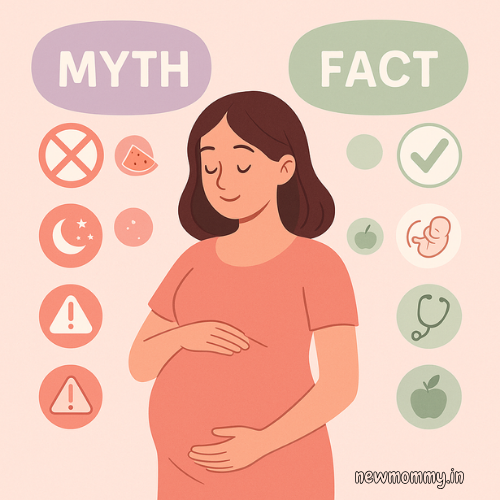
Why Pregnancy Myths Spread So Easily
I can still see the moment in my mind. I was four months pregnant, and at a family dinner, my aunt told me she was, “carrying low. It was a boy, there was no doubt about it, she said. I didn’t have low. I am not pregnant with a boy. I simply ate some dinner.
Which is the actual issue of the pregnancy myths. Everybody knows their opinion, and most of them are given by love — your mother, your neighbour, the man or woman at the supermarket, who reaches out and feels you in your belly without asking. Advice isn’t always right because it is love.
Such myths persist over time because they are passed down through generations, and pregnancy is an uncertain time. When you don’t know what ails you inside, a well-spoken rule is comforting, regardless of whether it’s true or false.
This article covers the 3 trimesters of pregnancy, common myths, and the facts about these myths, as outlined by WHO, ACOG, the NHS, and the AAP.
Myth 1: You’re Eating for Two
It’s likely the most repeated pregnancy myth in existence — and it’s easy to understand why, since you’d think you should simply double up on delicious food, right?
Both the ACOG and the NHS say there is very little increase in calorie requirements during the first trimester. Later, it’s not very high either – about 340 additional calories per day during the second trimester and 450 calories per day during the third.
Extra calories eaten during pregnancy also increases your risk for gestational diabetes and blood pressure. The aim isn’t about quantity of food. It’s better food.
What does work is to:
- Incorporate protein in your diet – eggs, lentils, paneer, chicken
- Add iron foods such as Spinach & Date Fruit
- Check with your healthcare provider to take a prenatal vitamin every day, preferably one that contains folic acid, iron and DHA.
- Eat smaller meals, but more often, particularly if you feel sick.
Myth 2: Morning Sickness Only Hits in the Morning
Just the name of the product brings a lot of uncalled for guilt for women who are feeling unwell throughout the day.
This nausea is caused by your hormones, primarily hCG and estrogen, which don’t take into account the clock. For some women, nighttime is the worst time. Others get a stomach ache for weeks after weeks.
What actually helps:
- Place dry crackers or toast next to your bed and have a few before you arise.
- Drink ginger tea or chew ginger candy in between meals.
- If the nausea is interfering with your activities of daily living, consult your doctor for some vitamin B6 or doxylamine.
- If unable to consume liquids over a 24 hour period, contact your doctor as this may be a sign of a condition known as hyperemesis gravidarum.
Myth 3: Belly Shape Predicts Your Baby’s Gender
.You’ve heard the phrase, “carrying high” and “carrying low” — it’s usually said with complete assurance, and it means what you think it means.
Belly shape is not dependent on gender, but rather on muscle tone, body type, the position baby is in this week, and number of pregnancies prior. A first pregnancy may be a higher one just because the muscle hasn’t stretched out prior to.
The only way to determine your child’s gender is to either do an ultrasound or a prenatal blood test.
Myth 4: Exercise Is Risky During Pregnancy
When women see two lines on a test, they typically become inactive as they are afraid any activity could affect the baby.
In fact, for most low-risk pregnancies, ACOG suggests being active as much as 150 minutes of moderate exercise per week. Exercising can help circulation, can control weight gain, can relieve back pain, and even help with the length of time it takes to labor.
During most of the trimesters:
- Walking
- Prenatal yoga
- Swimming
- Stationary cycling
- Strong light exercises performed properly.Properly performed, light strength training exercises.
Avoid high-risk activities such as contact sports, activities that involve a risk of falling, and activities that your doctor has warned you against.
Myth 5: Coffee Is Completely Off-Limits
Many mum-to-be’s panic when they realize they can’t drink coffee anymore.
ACOG says that moderate (less than 200mg daily or about one 12-ounce cup of coffee) amounts of caffeine are safe. That’s why the cap is important; studies show that higher levels increase the risk of miscarriage and lower birth weight.
Switches for when you get it itchy to change it up:
- Half-caf blends
- For pregnancy, there are a variety of herbal teas that are considered safe.
- Coffee that’s decaffeinated, containing some caffeine but not much.
Myth 6: You Can Only Sleep on Your Left Side
At the third trimester, someone will tell you that you can only lie on your left side.
The left side is recommended as it helps to circulate blood to the placenta, particularly during the final stages of pregnancy. However, the NHS is sure that getting used to a new position overnight is perfectly fine – your baby won’t be hurt if you are sleeping on your back or on the right side.
What actually helps:
- Don’t lie on your left side if you don’t want to for a pregnancy pillow, make it easier for you.
- When you notice that you’ve shifted, go back to your left side, don’t panic.
- Focus on getting to sleep rather than getting into a certain sleep position
Myth 7: Heartburn Means Your Baby Will Have a Lot of Hair
This myth has a small kernel of truth behind it, which is what makes it so persistent.
A frequently cited 2006 study found a mild link between heartburn severity and babies born with more hair, tied to higher estrogen levels. But it’s one small study — not something to rely on for predictions. Most heartburn in pregnancy simply comes from your growing uterus pressing on your stomach and a relaxed digestive valve letting acid rise.
What actually helps:
- Take smaller meals, more frequently, than large meals.
- NEVER lay down immediately after eating
- When in bed, elevate head slightly to help prevent swelling
- If it’s common, consult with your doctor about pregnancy-safe antacids
Myth 8: Sex Isn’t Safe During Pregnancy
Quite surprisingly many couples refrain from having sex for a period of nine months thinking it might affect their baby negatively.
In a healthy, low-risk pregnancy, sex is safe throughout. The amniotic sac, uterus, and cervix all protect your baby from any impact.
Avoid it only if your doctor has flagged placenta previa, a history of preterm labor, unexplained bleeding, or if your water has broken.
Myth 9: Stress Automatically Harms the Baby
This myth is an additional layer of stress — for pregnant women who worry that worrying is destructive to the baby.
Normal stresses such as a bad day at work or feeling overwhelmed are normal and do not harm your baby. Stress throughout pregnancy can be linked to potential effects on birth outcomes, not the typical stressors of life.
What actually helps:
- Try to establish some small, stress-relieving practices throughout the week — take some time for a walk, do some deep breathing, journal, etc.
- If you are still feeling anxious or low, talk to your doctor—help is available and it’s important!
- Don’t feel guilty because you think you’re hurting your baby on a bad day. It isn’t.
Myth 10: Every Pregnancy Is the Same
You may have heard from a friend or family member or even from someone with experience of having a baby before, “Well, my pregnancy wasn’t like that.
There are a number of ways two pregnancies can be very different in the same woman, with different cravings, different levels of energy, different symptoms. Comparing your pregnancy to another or to your previous one can cause undue worry
Myth 11: You Shouldn’t Color Your Hair or Go For a Manicure
This myth stops many expecting moms from going for a haircut that they had actually been looking forward to.
Fact: Most dermatologists and OBs believe that hair dye and regular nail polish are safe in pregnancy, particularly in the second trimester onward. The amount of chemical ingested via your skin or scalp while getting a salon treatment is insignificant. If you wish to err on the side of caution, then ammonia-free dye and properly ventilated salon would be a good compromise, not an absolute necessity.
Myth 12: Spicy Food Causes Labor
When you are in the last trimester, a lot of ladies are inclined to eat their most spicy curries to try and help get things moving faster.
The reality of the matter is that there isn’t any real scientific proof that spicy food causes labor. The one thing it may cause is some sort of indigestion or heartburn, which might seem like something is working, but it isn’t causing labor.
ACOG, WHO, NHS Guidelines and Your Obstetrician vs. a Message Forwarded on WhatsApp:
- When in Doubt, Refer to the Source {#acog-who-nhs-guidelines-and-your-obstetrician-vs-a-message-forwarded-on-whatsapp-when-in-doubt-refer-to-the-source}
- Think about “compared to what”. There are a number of pregnancy myths that are essentially about how much, not whether – caffeine is okay in small amounts; large amounts of caffeine are not.
- Take strange information to your next prenatal visit. Doctors hear this question all the time and would prefer you ask them rather than agonize about it.
- Remember that just because “my mother did it this way” doesn’t mean that’s the current recommendation; things have changed a great deal in maternal health research over the past twenty years.
Frequently Asked Questions FAQ
1.Isn’t it true you aren’t supposed to put your arms above your head when you are pregnant?
No. It’s an old wives’ tale that doesn’t have any medical truth. There’s nothing to prove that putting your arms above your head while pregnant will cause the umbilical cord to get around your baby’s neck.
2.Doesn’t stress cause miscarriage?
Daily stress doesn’t cause miscarriage. According to ACOG, most miscarriages are caused by chromosomal reasons that have nothing to do with stress levels.
3.Is it possible to travel by plane during pregnancy?
For most normal pregnancies, it’s possible to fly until about week 36 of pregnancy. However, the policy of airlines might differ, so it’s best to ask your OB before booking tickets.
4.Will I lose my tooth for each child?
No. You can blame this on pregnancy gingivitis and the increased risks of having the condition. It isn’t possible to lose teeth just because you are pregnant.
5.Can you determine the baby’s gender by its heartbeat?
No. The heartbeat can differ in every single baby and in every stage of pregnancy. This is one of the most popular but wrong myths about pregnancy.
Conclusion
There is already enough doubt surrounding pregnancy without having to believe in myths too. While much of this may come from genuine care, it is important to understand that care and facts are not synonymous terms.
Whenever you come across something that contradicts what your physician has told you, it would be worth it to ask. One question is all it will take to get rid of months of useless worrying.
Next step: Save this list. When an uncle or auntie gives you one of those rules of pregnancy at a family gathering, you will have the answer ready.
Affiliate Disclaimer: This post contains affiliate links. If you purchase :hrough these links, NewMommy.in may earn a small commission at no extra cost to you.